
Blog
Pump and Fan Systems: Where IE4 Motors Deliver the Fastest Payback

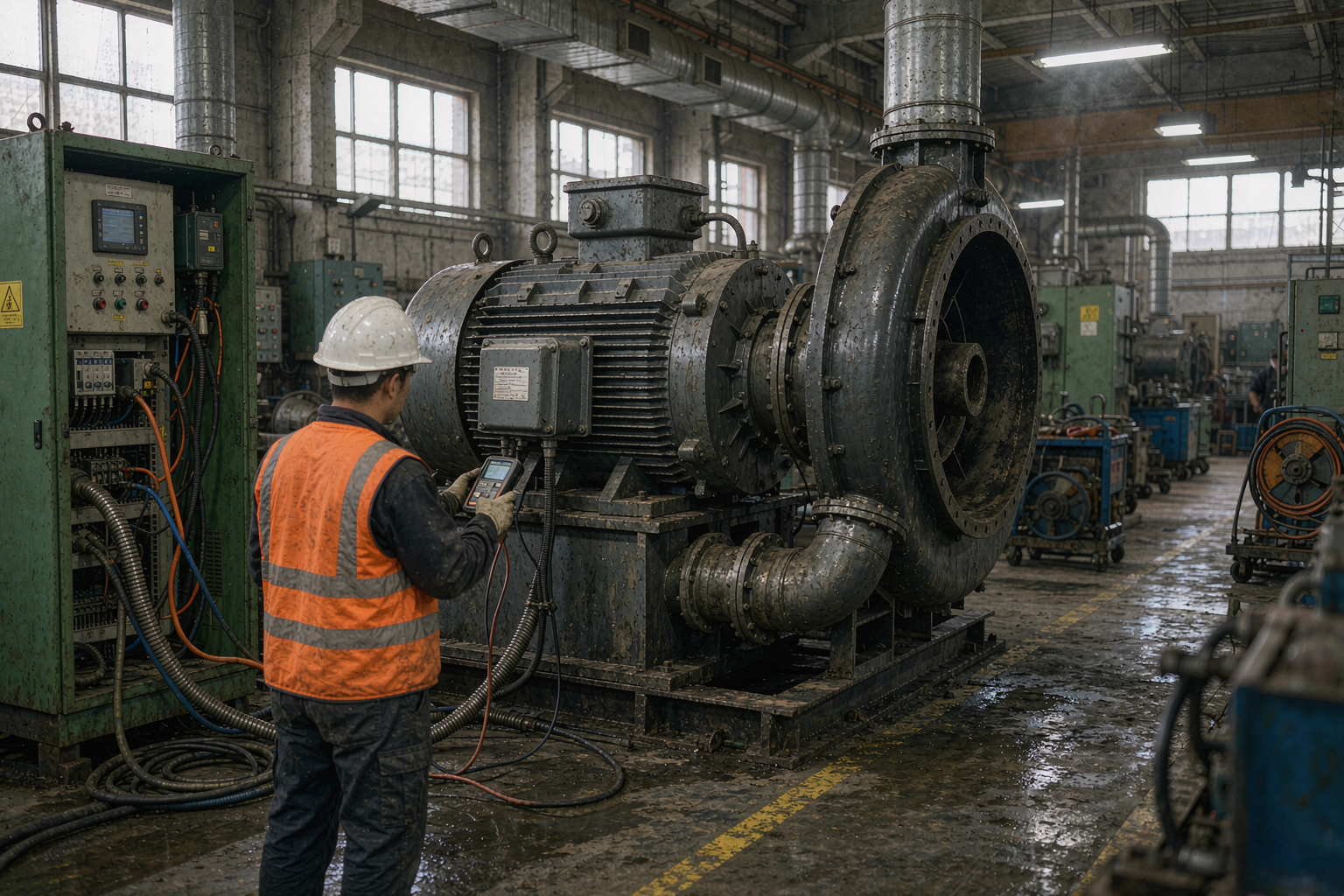
Pumps and fans are the workhorses of industry. They circulate cooling water, move process fluids, supply ventilation, drive air-handling systems and keep whole plants comfortable and safe. They also consume an enormous amount of electricity — in many facilities, motors driving pumps and fans account for a large share of the total load. This makes them the single best place to look for energy savings. Upgrading to a high-efficiency IE4 motor, combined with variable-speed control, can deliver one of the fastest paybacks available in industrial energy management. Understanding why requires a look at how these loads actually behave.
Why Pumps and Fans Are Different
Pumps and fans are variable-torque loads. Unlike a conveyor or a crusher, where torque demand stays roughly constant, the load on a pump or fan falls sharply as speed decreases. This relationship is described by the affinity laws: flow varies directly with speed, pressure varies with the square of speed, and power varies with the cube of speed. The practical consequence is powerful — reducing a fan’s speed by twenty percent can cut its power consumption by roughly half. Because most pumped and fanned systems are designed with generous safety margins, they frequently run well below their maximum requirement, throttled by a valve or damper that wastes energy. Replacing that throttling with speed control is where the savings begin.
The Waste in Throttling
Traditional pump and fan control often relies on a valve or damper to restrict flow while the motor runs at full speed. The motor keeps consuming nearly full power, and the throttling device dissipates the excess as heat, noise and turbulence. It is a bit like driving with the accelerator down and the brake half on. Variable-frequency drives (VFDs) take a different approach: they slow the motor to match the actual demand, so the affinity laws work in your favour. Even after accounting for drive losses, the energy reduction is usually dramatic, particularly in applications with widely varying demand such as heating and cooling, or processes that run at part load for much of the time.
Where the IE4 Motor Fits
The motor itself matters too. An IE4 super-premium efficiency motor converts a higher proportion of electrical input into useful mechanical output than a standard IE2 or IE3 machine, and it holds that efficiency across a broad operating range. On a pump or fan that runs thousands of hours a year, even a two- or three-percentage-point efficiency gain translates into substantial savings. When an IE4 motor is paired with a VFD, the two improvements compound: better efficiency at every operating point, plus far fewer operating hours at full speed.
It is worth noting that IE4 and IE5 motors often use designs — such as permanent-magnet or synchronous reluctance technology — that maintain high efficiency at part load, exactly where pumps and fans spend most of their time. That makes them especially well suited to variable-speed duty.
Calculating the Payback
A straightforward payback assessment starts with the motor’s power rating, annual running hours, electricity cost and expected load profile. A higher-efficiency motor saves the difference in losses multiplied by running hours and tariff. Speed control adds the affinity-law savings, which are often much larger than the motor-efficiency gain alone. Because pumps and fans commonly run 4,000 to 8,000 hours per year, payback periods of one to three years are common, and shorter in high-tariff or continuous-duty plants. Utility rebate programmes for high-efficiency motors and VFDs can shorten payback further.
Selection and Installation Considerations
- Match the motor to the real duty point. Oversized motors running lightly loaded are inefficient and costly. Size to the actual demand, with reasonable margin.
- Check VFD compatibility. Confirm the motor is suitable for inverter duty, especially regarding insulation and cooling at low speeds.
- Consider cooling at low speed. A shaft-mounted fan loses effectiveness as speed drops; a separately powered cooling fan may be needed for sustained low-speed operation.
- Protect against harmonics and bearing currents. VFDs can introduce electrical noise and shaft currents; appropriate filters and bearing protection extend motor life.
- Commission and measure. Verify flow, pressure and power after installation so the expected savings are actually realised.
Beyond Energy: Reliability and Control
The benefits extend beyond the electricity bill. Soft acceleration from a VFD reduces mechanical stress on belts, couplings, bearings and impellers, lowering maintenance costs and extending equipment life. Gentle ramp-up eliminates water hammer in pumping systems and pressure surges in ducts. Better control also improves process consistency — steadier pressure, more stable temperatures and quieter operation. For many plants these operational gains are as valuable as the energy savings.
A Practical First Step
Because pumps and fans are numerous and energy-hungry, they offer a low-risk starting point for an efficiency programme. Begin with the largest, longest-running machines, measure their duty cycles, and model the savings from an IE4 motor plus variable-speed control. The numbers are usually compelling, and the payback is fast enough to fund the next upgrade.
If you are planning to upgrade pumps, fans or air-handling systems, the team at https://motorolltech.com can help you select the right high-efficiency motor and control package for your duty. Reach out today to discuss your application and request a tailored recommendation.