
Blog
Choosing IE3, IE4, and IE5 Motors for Textile Mills: Spinning, Weaving, and Continuous Duty

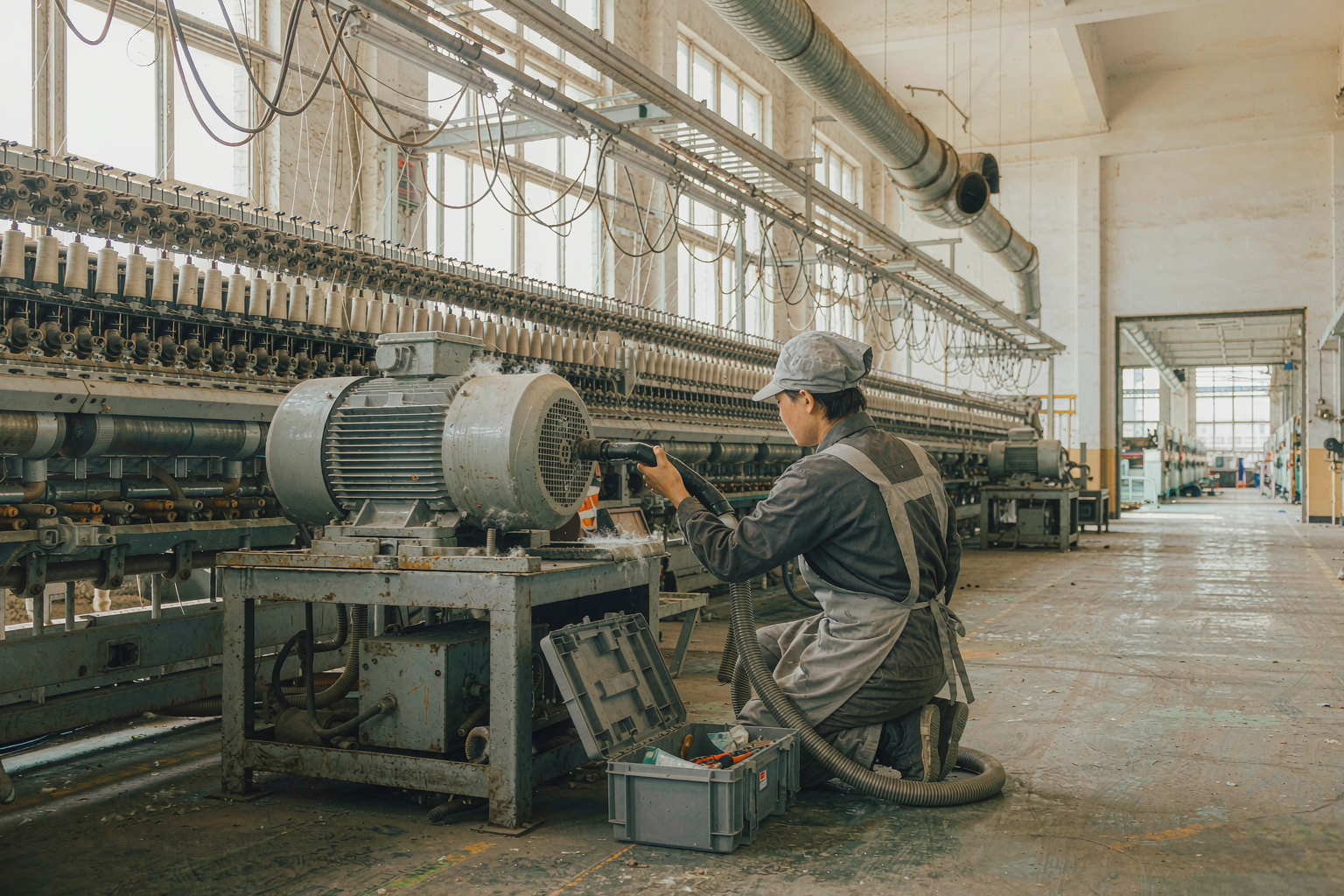
Textile Mills Run Motors Hard — Tier Selection Shows Up on the Power Bill
Textile manufacturing is one of the most motor-intensive industries in existence. Spinning frames, ring spinners, looms, winders, carding machines, compressors for air-jet weaving, and the HVAC systems that keep humidity stable all run for 20 or more hours a day, in environments full of lint and dust. When plant engineers compare IE3 vs IE4 vs IE5 motor efficiency for this duty, the math is unusually favorable: high running hours multiply every percentage point of efficiency into serious money.
This guide walks through where each tier makes sense in a mill, what the lint-rich environment demands from motor construction, and how to organize an upgrade program that pays for itself.
Where Motors Live in a Textile Plant
The motor population of a typical mill divides into three groups. First, continuous process drives: spinning and winding machines that run at nearly constant load for entire shifts, with annual running hours that can exceed 7,000. Second, variable-load drives: HVAC and humidification fans, compressors, and pumps, where demand follows the season and the production schedule. Third, packed-area drives: carding and opening lines with dusty air and frequent start-stop duty.
Each group rewards a different strategy. The continuous group is where efficiency upgrades deliver the fastest payback, because every operating hour converts motor losses directly into electricity cost and heat. The variable-load group benefits from combining higher efficiency tiers with variable frequency drives, since most of the saving comes from speed reduction. The packed-area group cares most about enclosure, cooling, and maintenance access — efficiency matters, but survivability in lint decides total cost of ownership.
IE3 vs IE4 vs IE5 Motor Efficiency: The Tier Comparison in Mill Conditions
The technical baseline is the same as in any industry. Under IEC 60034-30-1, IE3 marks the premium efficiency level, IE4 the super premium level, and IE5 the ultra premium level, with each tier defined by roughly a 15–20% reduction in losses versus the tier below. Translating that into mill conditions gives three practical conclusions.
For continuous spinning and winding drives above roughly 15 kW, the loss reduction from IE3 to IE4 is worth calculating seriously: at 7,000 operating hours per year, the energy saving often pays back the price difference within a few years, and every kilowatt-hour saved also removes heat from an already hot spinning hall, easing the HVAC load. For the humidification fans and compressors that run long hours at partial load, IE5 SynRM or permanent magnet motors hold their efficiency advantage across the load range far better than induction machines, whose magnetizing losses persist even at light torque. And for small, low-hours motors scattered through auxiliary equipment, the gap between tiers shrinks to trivial annual amounts, and IE3 remains the rational default.
One mill-specific point deserves emphasis: heat. Every percentage point of lost electrical energy becomes heat inside the workroom, and textile processes are acutely sensitive to humidity and temperature stability. Higher efficiency tiers therefore do double duty — they cut the electricity bill and they reduce the thermal load that the humidification plant has to fight.
Lint, Dust, and the Enclosure Question
Efficiency class is only half the specification in a textile environment. Airborne lint and fiber dust clog ventilation paths and cooling fins, and a motor that is efficient when clean can lose several points of real-world performance when its cooling surface is blanketed in fiber. This is why mills should specify totally enclosed fan-cooled (TEFC) or dust-protected constructions for packed areas, plan regular cleaning into the maintenance schedule, and check that cooling air intakes point away from fiber sources.
IE5 SynRM packages, which are typically sold as motor-plus-drive units, have a thermal advantage here: their lower losses mean less heat to reject in the first place, so they tolerate a dustier cooling environment better than a high-loss IE3 machine of the same frame size. Permanent magnet and SynRM designs also tend to run cooler at partial load, which extends bearing and insulation life in hot spinning halls.
Organizing the Upgrade Program
Trying to upgrade an entire mill at once rarely makes sense. The proven approach is a ranked program: list the motor fleet with power rating, annual running hours, and current tier; sort by annual energy cost; and replace or re-specify the top of the list first — usually the big continuous drives and the humidification fans. Where a drive is already installed, the marginal cost of choosing a higher-tier motor is small and the saving is immediate. Where a motor fails unexpectedly, treat the replacement decision as the natural upgrade window: fitting an IE4 or IE5 machine instead of repeating the old tier usually pays for itself over the remaining life of the driven machine.
Keep the procurement side simple as well. Ask suppliers for efficiency values at rated load and at the partial-load points your process actually runs, request inverter-duty specifications where drives are involved, and verify that the frame sizes, mounting, and cooling arrangements match existing foundations to keep installation cost predictable.
What Buyers Should Put in the Specification
A concise specification avoids most disputes. State the required efficiency class per motor group, the applicable IEC 60034-30-1 edition, the enclosure and cooling type for lint-rich zones, the supply arrangement (grid or drive), and the expected partial-load points. Require test certificates per IEC standards for efficiency, and where IE5 packages are used, ask for the combined motor-drive efficiency data rather than motor-only figures, because that is what your energy audit will actually see.
From Comparison to Order
The IE3 vs IE4 vs IE5 motor efficiency comparison stops being abstract the moment it is attached to real running hours — and textile mills have more of those than almost any other industry. Rank your fleet by energy cost, upgrade the top of the list first, and match the tier to the duty instead of buying one class everywhere.
Get a Motor Fleet Assessment for Your Mill
Our team supplies IE3, IE4, and IE5 motors — including SynRM and permanent magnet packages for partial-load fans and compressors — and helps textile manufacturers build ranked upgrade programs with payback calculations for their actual duty profiles. If you want the motor efficiency comparison applied to your spinning halls, weaving lines, and HVAC plant, visit motorolltech.com and send us your motor list for a structured proposal.