
Blog
IE5 Motors in HVAC Chillers and Air Handling Units: Where Part-Load Efficiency Pays

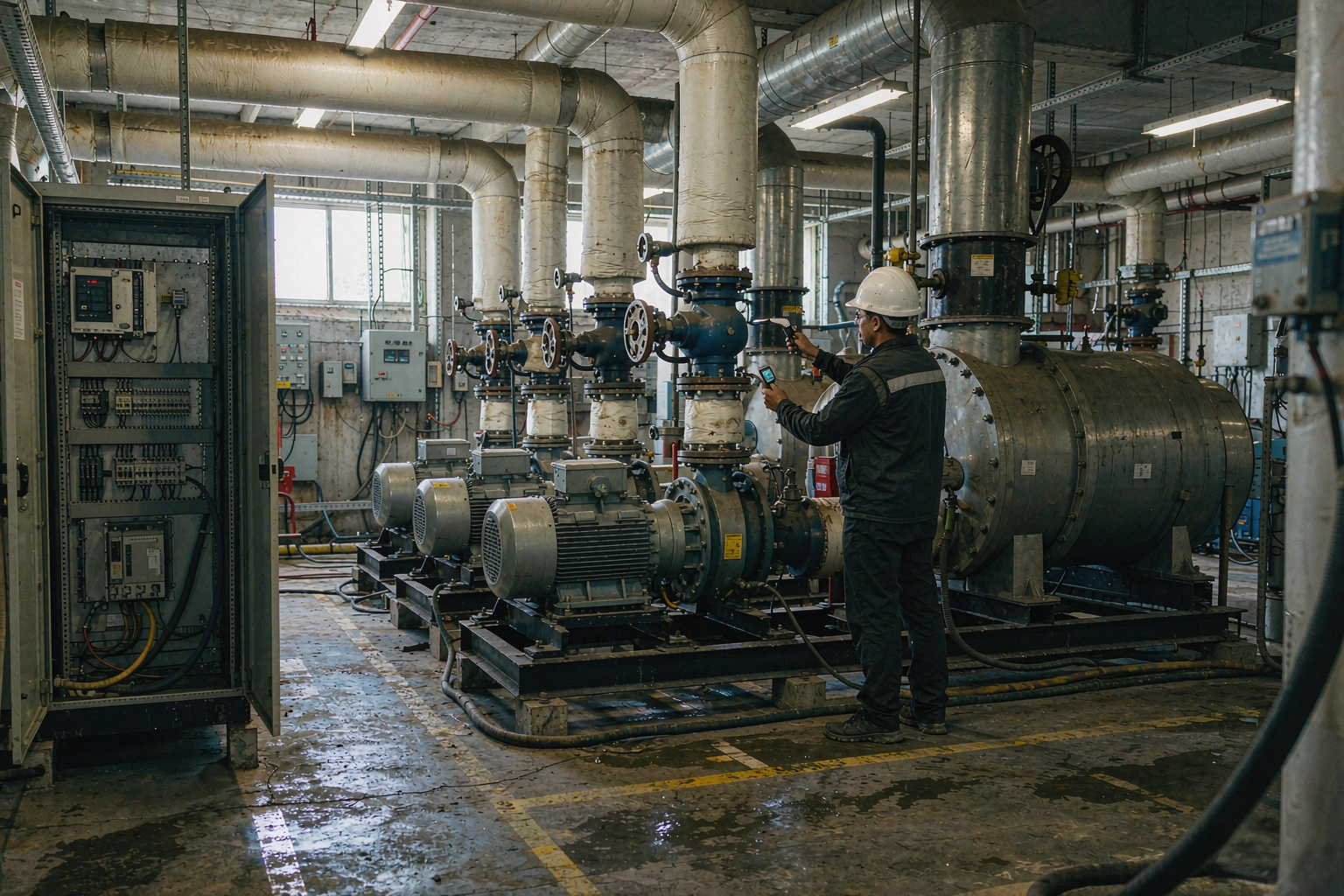
When a chiller is specified, the conversation almost always starts at full load: nominal cooling capacity, rated power, and the efficiency figure on the datasheet. But a chiller rarely runs at full load. Across a typical year it spends most of its hours at part load, tracking a building’s changing thermal demand. That mismatch is where IE5 motor efficiency stops being a line item and starts being a real operating advantage – especially in the compressors, fans and pumps that make up the HVAC plant.
The Part-Load Reality of HVAC
Commercial buildings are dynamic. Occupancy shifts through the day, solar gain changes with the seasons, and outside air temperature swings hour to hour. A chilled-water plant sized for the hottest afternoon in August may run at 30 to 60 percent of capacity for the majority of the year. Air handling unit (AHU) fans modulate to maintain static pressure; condenser water pumps throttle or slow to match heat rejection; centrifugal and screw compressors unload, slide, or vary speed.
Every one of those rotating machines is driven by an electric motor, and the efficiency of that motor is not constant. Induction motors lose efficiency as load falls below roughly 60 to 75 percent. Their slip increases, power factor drops, and fixed losses – core and friction – become a larger fraction of output. This is exactly the region where HVAC equipment spends much of its life.
Why IE5 Changes the Curve
IE5 is the highest efficiency class in the IEC 60034-30-1 framework. Most commercial IE5 motors achieve this rating using one of two technologies: permanent magnet (PM) synchronous motors, or synchronous reluctance motors (SynRM) with or without magnets. Both eliminate rotor slip, which means speed stays locked to supply frequency (or to a VFD-set frequency) right down into the low-load region.
The practical benefit shows up in three places. First, at part load an IE5 PM or SynRM motor holds its efficiency far better than an induction motor, so the annual energy use is much lower than a nameplate comparison suggests. Second, because there is no rotor slip, a VFD can trim speed precisely, which matters enormously for fan and pump duty where the affinity laws mean a small speed reduction yields a large power reduction. Third, these motors typically run cooler and with a higher power factor, easing the load on the building’s electrical distribution and reducing reactive-power penalties.
Where IE5 Pays Back Fastest in a Chiller Plant
Not every motor in an HVAC plant justifies an IE5 upgrade equally. The best returns appear where hours are long and load is variable.
Chiller compressors. On screw and centrifugal chillers, the compressor is the single largest consumer. Where the compressor motor is replaced or specified new, IE5 technology – often paired with variable-speed control – delivers the biggest absolute energy saving. The premium over IE3 or IE4 is recovered quickly in a machine that runs thousands of hours each year.
AHU and fan-coil fans. Fans follow the cube law: halving airflow cuts shaft power to roughly one eighth. When an IE5 motor is combined with a VFD and the fan actually slows down during mild weather, the savings compound. This is one of the most reliable retrofit opportunities in an existing building.
Condenser and chilled-water pumps. Constant-volume pumping is a classic source of waste. Pairing an IE5 motor with variable-speed control and a differential-pressure reset lets the plant move only the water it actually needs. Because pumps often run day and night, the payback is short.
Cooling tower fans. These see wide seasonal variation and are natural candidates for speed control. An IE5 motor holds efficiency through the many low-speed hours that dominate the year.
Integration: The VFD Is Part of the Decision
An IE5 motor does not deliver its part-load advantage in isolation. To exploit the no-slip, variable-speed characteristic, it must be matched with a suitably sized VFD, and the drive’s own losses must be accounted for. A drive running at high switching frequency or with a poorly matched motor can erase part of the gain. Specify the motor and drive together, verify compatibility (especially for PM motors, which require the drive to handle permanent-magnet control), and commission with the vector or sensorless control mode recommended by the manufacturer.
Harmonics also deserve attention. A building full of VFDs injects harmonic currents back into the distribution system. Depending on the installation, a line reactor or an active harmonic filter may be needed to protect power quality and meet the site’s compliance limits. This is a system-level decision, not a motor decision, but it belongs in the same design review.
Building the Business Case
To make a convincing case, model the annual load profile rather than a single design point. Break the year into load bins – for example, hours at 20, 40, 60, 80 and 100 percent – and apply the motor efficiency at each bin along with the drive and equipment efficiency. Compare the IE5 scenario against an IE3 or IE4 baseline. In most commercial buildings, the incremental cost of IE5 over IE4 is recovered within two to four years through energy savings alone, and faster where electricity prices are high or where demand charges reward lower peak power.
Do not forget maintenance and reliability. Permanent-magnet and SynRM motors run cooler, which reduces thermal stress on insulation and bearings. Fewer unplanned stops in a chiller plant matter to building occupants far beyond the energy line. And as efficiency regulations tighten worldwide, specifying IE5 now avoids a forced upgrade later.
Specifying with Confidence
Start with the motors that run the most hours at variable load. Confirm the supply voltage and the drive compatibility, check that the mechanical interface matches the existing equipment, and model the load profile before committing. When the numbers are done properly, IE5 in HVAC is rarely a hard sell – the part-load hours do the arguing for you.
To explore IE3, IE4 and IE5 motor solutions for HVAC applications, visit https://motorolltech.com.