
Blog
Selecting IE4 Motors for Solar-Powered Water Pumping in Off-Grid Irrigation

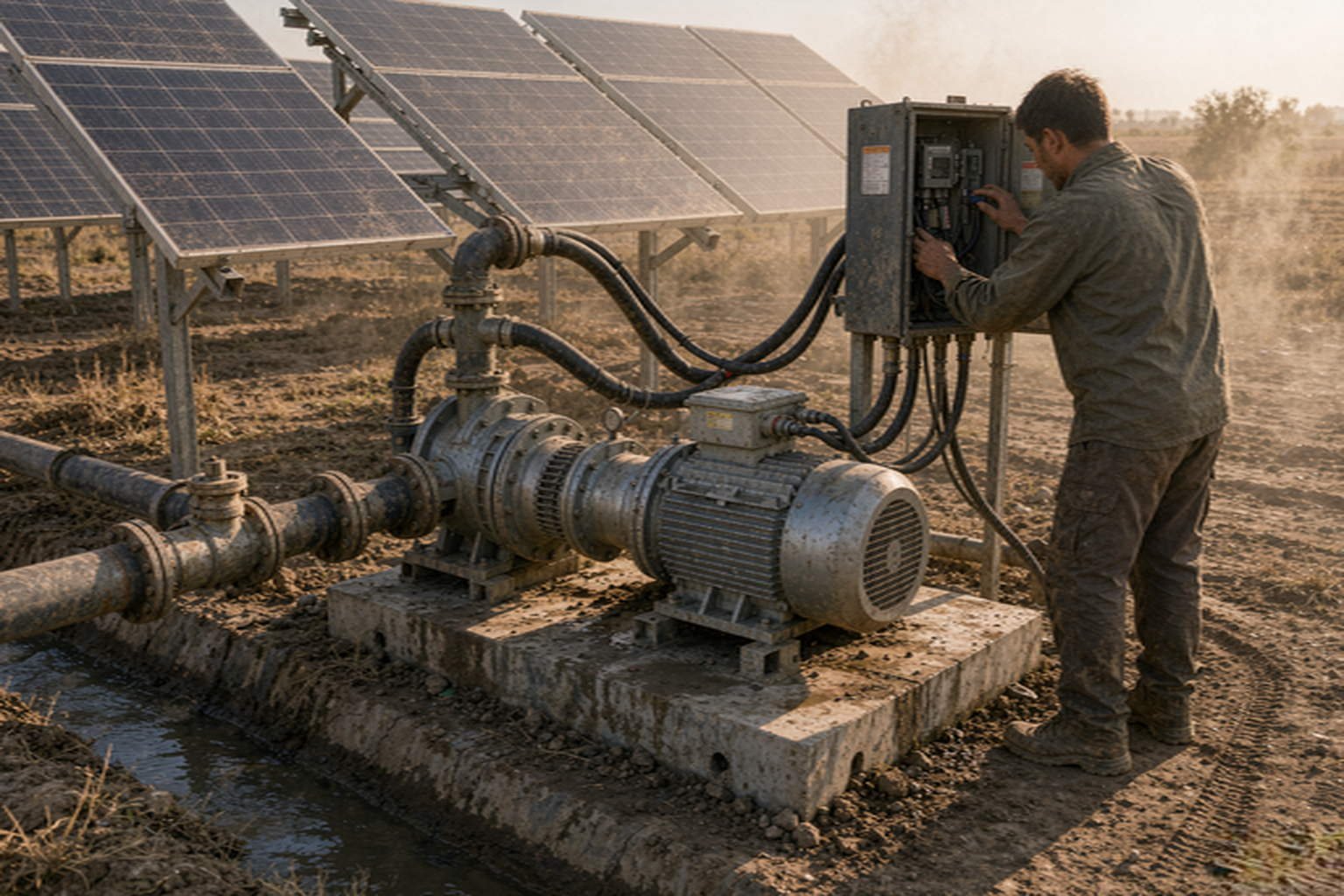
Solar-powered water pumping is one of the most compelling applications in rural electrification and off-grid irrigation. The sun is free, the resource is abundant, and pumping demand often peaks exactly when solar output is highest. But a solar pump system is unforgiving of poor motor selection. The power supply fluctuates, the load varies with water level and pipe friction, and there is no grid to fall back on. Choose the motor carefully – typically an IE4-class unit paired with the right drive – and the system delivers reliable water for years. Choose badly and it stalls, overheats, or wastes a precious fraction of the solar array.
What Makes Solar Pumping Different
A grid-connected pump sees a stiff voltage and frequency. A solar pump sees neither. Irradiance changes minute by minute as clouds pass, and it follows a predictable daily curve from zero at dawn to a noon peak and back to zero at dusk. The inverter or variable-frequency drive (VFD) feeding the motor must track that curve, extracting maximum power from the array while keeping the motor within its safe operating envelope.
The hydraulic load is equally dynamic. In a borehole application, the water level may fall through the dry season, increasing the total dynamic head the pump must overcome. In a surface irrigation system, filters clog and pipelines change configuration as valves open and close. A motor that is comfortable at one operating point can be overloaded at another.
Why Efficiency Matters More Off-Grid
On the grid, a few percentage points of motor loss are paid for by the utility. Off-grid, every watt lost is a watt that must be generated by a solar panel – and panels, batteries and inverters are the most expensive parts of the system. A more efficient motor lets you install a smaller array for the same water output, or deliver more water from the same array. That is why an IE4 motor is not a luxury here; it is a way to reduce the single largest capital cost.
IE4 (Super Premium) efficiency delivers this with conventional induction-motor robustness. In remote areas, that robustness matters. IE4 induction motors tolerate voltage fluctuation, dust, and less-than-perfect maintenance better than more exotic technologies, while still cutting losses meaningfully versus IE1 or IE2 units. For many off-grid projects, IE4 is the sweet spot between efficiency and field durability.
Matching Motor and Pump
The first selection decision is the pump type. Solar borehole applications commonly use multi-stage centrifugal submersible pumps; surface applications use centrifugal or, where head is high and flow low, progressive cavity or piston pumps. Each has a different torque-speed signature.
Centrifugal pumps are variable-torque loads: torque rises with the square of speed, and power with the cube. This is ideal for solar because the drive can slow the pump at low irradiance and still move water. The affinity laws mean that at half speed the pump consumes only about one eighth of full power – a perfect match to a morning or evening sun. Size the motor so that its rated point sits near the pump’s best efficiency point at the expected operating head, with enough margin for seasonal head rise.
Positive-displacement pumps behave differently: torque is roughly constant with speed. They need high starting torque and a motor that can handle a near-constant load across the speed range. Confirm the motor’s starting torque and the drive’s current limit carefully – a stalled positive-displacement pump against a closed valve is a reliable way to burn out an undersized motor.
The Drive Is the Brain of the System
A solar pump controller is more than a VFD. It performs maximum power point tracking (MPPT), continuously adjusting the operating point so the array delivers its available power as conditions change. When irradiance falls, the controller reduces motor speed rather than letting the system collapse. At very low light it shuts down cleanly and restarts smoothly when the sun returns.
Specify a drive designed for solar pumping, with built-in MPPT, dry-run protection, and motor thermal protection. Verify voltage range against the array configuration, and make sure the drive can deliver the motor’s starting current without nuisance tripping. Many controllers also offer input for a water-level sensor and a float switch, so the pump stops when the tank is full or the borehole is drawn down. These protections are not optional in unattended installations.
Dealing with Dust, Heat and Water
Off-grid sites are often harsh. Dust is the Enemy of cooling: a motor’s fan draws airborne grit across its fins, and a clogged cooling path raises winding temperature fast. Specify an appropriate enclosure – TEFC (totally enclosed fan-cooled) as a minimum, with sealed or regreasable bearings suited to the dust load. In very dusty or sandy locations, consider a TENV or a motor with an external cooling arrangement, and plan a simple cleaning routine.
Ambient temperature is the second enemy. Motors are rated at a reference ambient, typically 40 °C. A pump installed in a hot, sun-exposed enclosure may see considerably more. If the site runs hot, request a motor with a higher temperature class or a service factor, and provide shade and ventilation. Derating a motor that will live in a hot box is not optional – it is the difference between a five-year life and a five-month failure.
For submersible motors, water ingress is the constant risk. Use a motor designed for continuous submersion, with a proper seal and, where available, a fill-fluid that tolerates the operating temperature. Check the cable and the wellhead seal as carefully as the motor itself.
Sizing Workflow and Common Mistakes
A reliable sizing workflow looks like this: establish the required daily water volume, determine the static and dynamic head, choose a pump that meets flow and head near its best efficiency point, calculate hydraulic power and divide by the expected overall efficiency to get motor power, then apply margins for head rise, aging and dust. Cross-check the result against the available solar resource at the site – a system that only works in ideal conditions is not a system that works.
Common mistakes are consistent. Oversizing the motor “to be safe” wastes array capacity and can lead to poor part-load efficiency. Undersizing for future head rise causes late-season failure. Ignoring starting current produces nuisance trips at dawn. And skipping dry-run protection turns a declining water table into a destroyed pump.
A Reliable Supply of Water
Solar pumping rewards careful engineering. An IE4 motor with the right enclosure, matched to the pump and guided by a solar-specific MPPT controller, turns an intermittent resource into a dependable one. Get the selection right and the system will deliver water quietly, efficiently and without attention for years.
To discuss IE4 motors and drive solutions for solar water pumping, visit https://motorolltech.com.