
Blog
Selecting Motors for Cranes and Hoists: Duty Cycle, Braking and Reliability

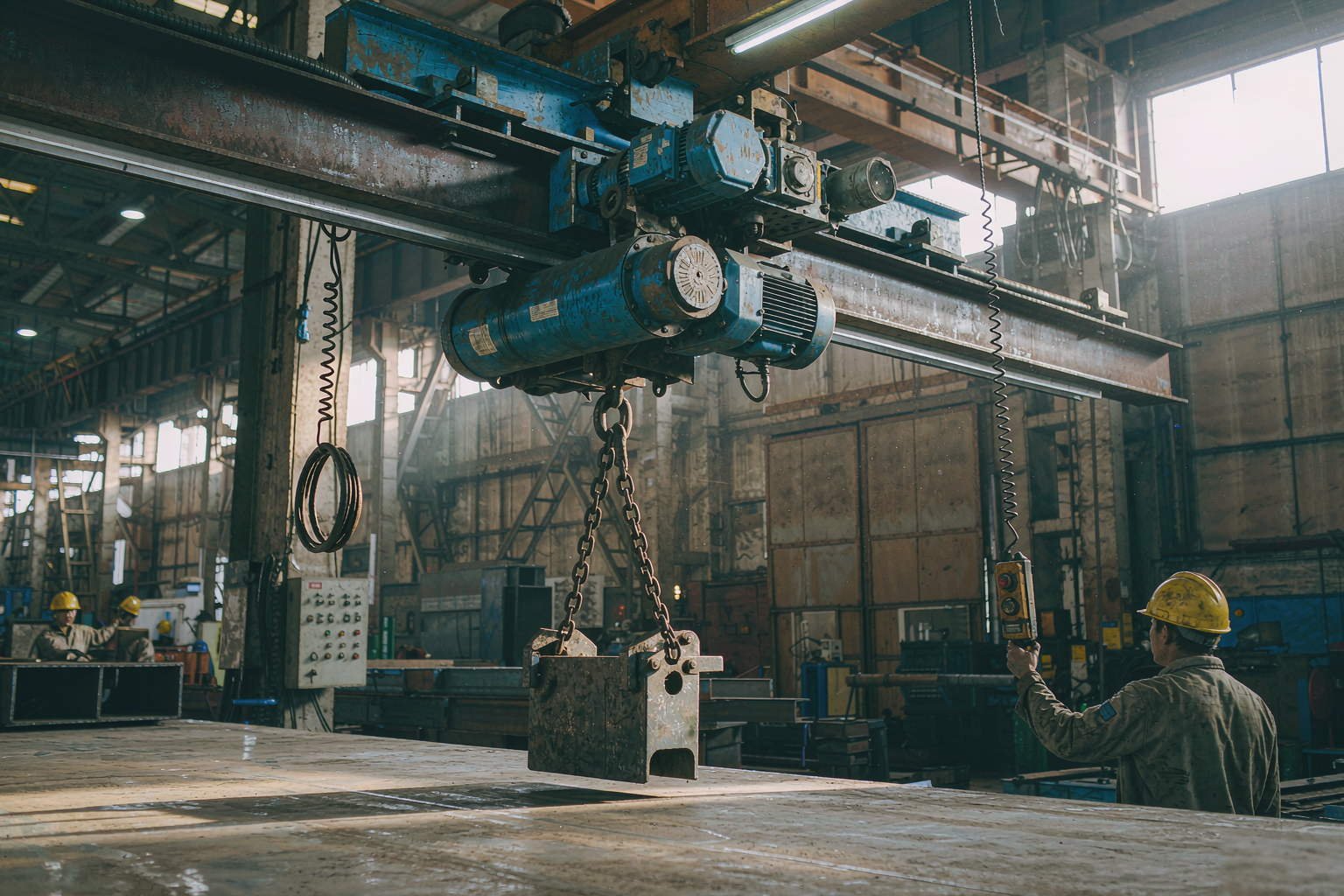
Why Cranes and Hoists Are a Special Motor Problem
A crane or hoist is not a continuous-duty machine in the usual sense. It starts and stops many times an hour, reverses direction under load, holds a suspended mass without movement, and often operates in dust, heat or outdoor weather. This pattern is classified by duty cycle rather than by raw power alone. A motor that is perfectly adequate for a conveyor running steadily can fail prematurely on a hoist that makes hundreds of loaded starts per hour, because the real enemy is not average power but repeated heating from starting current and frequent acceleration.
Getting the selection wrong shows up in predictable ways. Windings degrade from repeated thermal cycling, bearings fail early from high radial loads and reversal, brakes wear rapidly, and the drive trips on overcurrent during acceleration. Because the load is suspended overhead, reliability is also a safety matter. Specifying a motor for lifting duty deserves more care than a routine replacement.
Reading the Duty Cycle and Rating
International standards describe duty by patterns such as S3, S4 and S5, which cover intermittent periodic operation with varying degrees of starting and braking influence. Hoist manufacturers also use classification systems that reflect how often the machine lifts, how heavy the average load is, and how many operating hours accumulate. A motor selected for lifting should be explicitly rated for this intermittent, high-start duty, sometimes referred to as a wobbler-rated motor in overhead crane service.
Two numbers matter beyond the nameplate kilowatt rating. The first is the allowable number of starts per hour, which reflects how much starting heat the insulation and rotor can absorb. The second is the duty factor, the fraction of a cycle during which the motor is actually energised. A motor that is slightly oversized on power but correctly rated for starts and duty will often outlast a nominally matched motor that is not.
Induction, Wound-Rotor and Permanent-Magnet Options
Traditional crane duty used wound-rotor induction motors with external resistors to limit starting current and provide speed control. They are rugged but waste energy in the resistors and need regular maintenance of slip rings and brushes. Squirrel-cage induction motors paired with a variable frequency drive are now the common choice. The drive provides controlled acceleration, precise speed holding at low speed, and braking without mechanical wear on the motor itself.
Permanent-magnet motors offer higher efficiency and better torque density, which is valuable where space and weight are constrained, such as on a travelling trolley. They also maintain high efficiency at the low speeds common in positioning a load. The trade-off is cost and the need for a compatible drive. For high-cycle applications, the energy saving and reduced heating can justify the premium, particularly on electric chain hoists and smaller trolleys.
Braking, Safety and Regeneration
Controlling a suspended load is the defining safety requirement. Most hoists use a mechanical holding brake that engages when power is removed, backed by the drive’s ability to control speed during lowering. When a variable frequency drive is used, regenerative capability becomes a major consideration. Lowering a heavy load drives the motor as a generator, and the energy must go somewhere. Older systems dissipate it in braking resistors as heat. Regenerative drives return it to the supply, cutting energy use and removing a heat source from the control cabinet.
Key points to settle during specification include the following.
- Brake arrangement: Confirm that a fail-safe mechanical brake holds the load when power fails, and that the drive releases it only under controlled conditions.
- Regenerative capacity: Size the regenerative unit for the worst-case lowering load, not the average, so the DC bus does not overvoltage on a heavy descent.
- Low-speed control: Verify stable torque at creeping speeds, where sensorless vector control can struggle. Encoder feedback may be warranted for precise positioning.
- Thermal protection: Fit temperature sensors in the windings and set drive protection to match the motor’s intermittent rating, avoiding nuisance trips while preventing overheating.
- Brake resistors: If regeneration is not economical, ensure resistors are rated for the duty and mounted where their heat is safely dissipated.
Environmental Protection and Mechanical Details
Cranes work in some of the least forgiving environments in a plant. Steel mills and foundries combine dust with high ambient temperature. Ports and outdoor yards add rain, salt and wide temperature swings. Select an enclosure and protection rating appropriate to the location, and pay attention to the cooling method, since a totally enclosed motor in hot ambient conditions may need derating or forced ventilation. Sealed bearings and high-temperature grease extend service intervals where access for maintenance is difficult.
Mechanical details also drive reliability. Check the shaft and coupling arrangement for the radial loads imposed by the rope drum or wheel drive. Verify the mounting orientation, since hoist motors often operate with the shaft vertical or at awkward angles, which affects bearing selection and lubrication. Confirm that the drive and motor are matched to the supply, including any harmonics mitigation required where many cranes share a bus.
Making the Right Choice
Begin by documenting the real duty: lifts per hour, average and maximum load, cycle time, lowering profile and ambient conditions. From that data, derive the required starts per hour and duty factor, then shortlist motors rated for intermittent lifting duty. Compare a variable-frequency induction package against a permanent-magnet option on both energy and total cost of ownership, including braking and thermal management.
A correctly specified motor improves safety, reduces unplanned stops and lowers energy cost over a long service life. To discuss a crane or hoist motor selection, request a duty-cycle review, or compare regenerative and resistor-based drive options, visit https://motorolltech.com and speak with our engineering team.