
Blog
Motor Speed, Slip, and Nameplate RPM: What Matters in Pump and Fan Selection

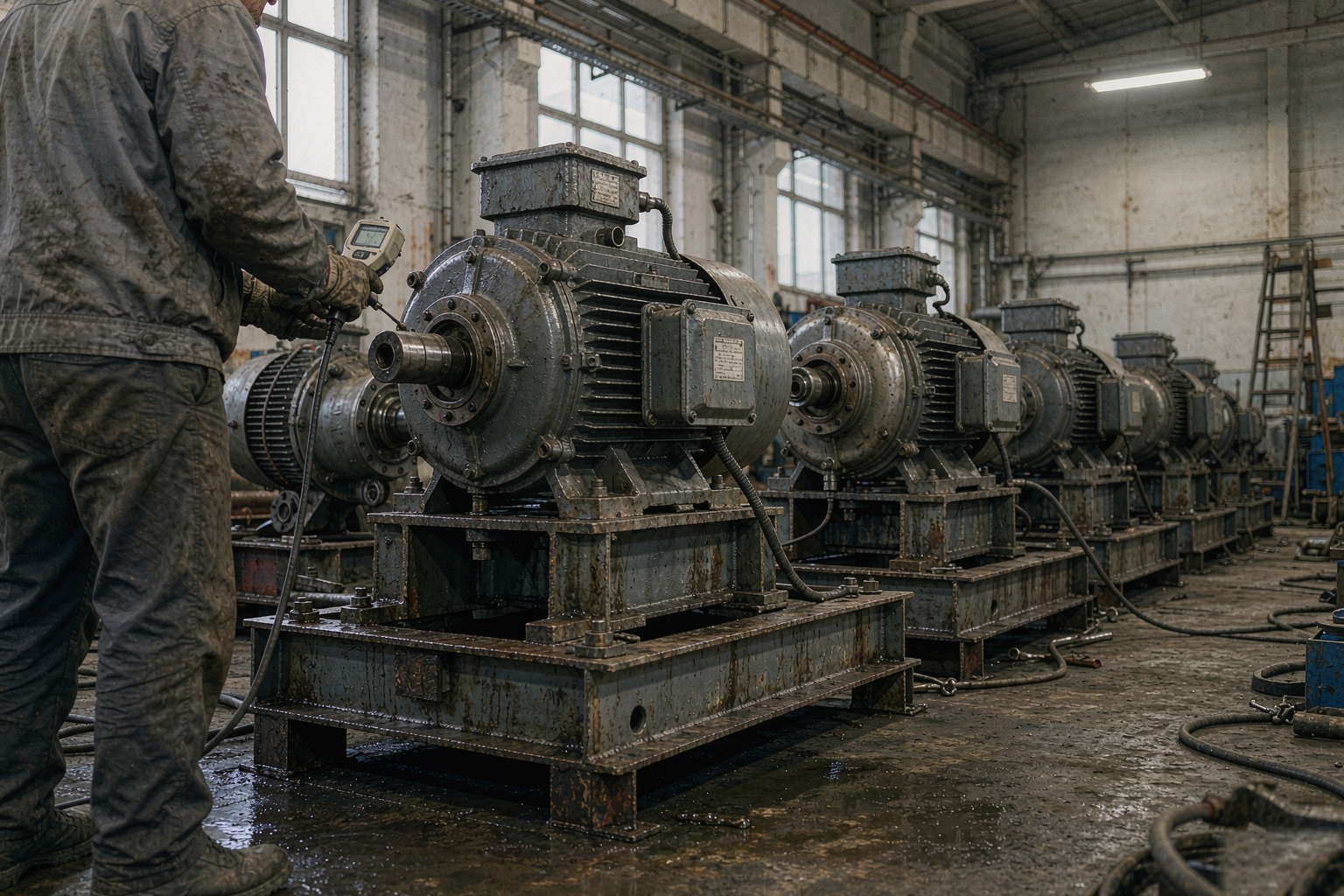
When an engineer replaces a motor, the first questions are usually about power and frame size. Yet two of the most consequential numbers on the nameplate receive far less attention: rated speed and slip. Get those wrong and a perfectly sized motor can deliver the wrong flow, overheat a driven machine, or waste energy for the entire length of its service life. Understanding nameplate RPM and slip is one of the highest-value skills in motor selection, particularly for pumps, fans, and other variable-torque loads.
Synchronous speed versus actual speed
Every induction motor has a synchronous speed — the theoretical speed of its rotating magnetic field — determined by the supply frequency and the number of pole pairs. The familiar formula is 120 × frequency ÷ poles, expressed in revolutions per minute. On a 50 Hz supply, a two-pole motor has a synchronous speed of 3000 rpm, a four-pole motor 1500 rpm, and a six-pole motor 1000 rpm. On a 60 Hz supply the corresponding figures are 3600, 1800, and 1200 rpm.
The rotor never quite reaches synchronous speed. If it did, there would be no relative motion between the rotating field and the rotor conductors, and therefore no induced current and no torque. The rotor must lag behind the field, and that difference is called slip. A motor’s nameplate shows the full-load speed, which is the synchronous speed minus the slip at rated load. A typical four-pole, 50 Hz motor might be listed at 1440 rpm: 60 rpm below synchronous, a slip of about 4%.
Why slip matters in practice
Slip is not a defect; it is how an induction motor makes torque. But its magnitude changes with load. At no load, slip is close to zero and the rotor turns near synchronous speed. As load increases, slip grows and speed falls. This relationship is visible in the motor’s torque-speed curve and has direct consequences for driven equipment. A centrifugal pump is a classic example: its flow varies approximately with speed, and its head with the square of speed. A small difference in operating speed produces a noticeable difference in process performance.
Consider a pump specified for a motor with a nameplate of 1470 rpm that is replaced with a motor rated 1440 rpm. The new motor is the same power and frame, but the driven pump now turns about 2% slower. Flow drops roughly 2%, and head drops about 4%. In a system where the pump was already near its duty point, that change can be enough to push the process out of specification. Conversely, a motor with unusually low slip — a premium-efficiency design, for example — can run slightly faster than the machine it replaces, raising flow and power draw.
Reading the nameplate correctly
The nameplate speed is a full-load value at rated voltage and frequency. It is not a guaranteed operating speed, and it is not necessarily the speed you will measure in the field. Motors of the same power and pole count from different manufacturers can have nameplate speeds differing by 1–2% depending on their slip design. High-efficiency motors often have lower slip because better rotor conductors reduce losses, which makes them run closer to synchronous speed. When matching a replacement motor to an existing machine, compare the nameplate RPM, not just the kilowatt rating.
Frequency is the other half of the equation. A motor designed for 50 Hz will run about 20% faster on a 60 Hz supply, and the driven load will follow. That may be harmless for some machines and destructive for others. Always confirm the supply frequency and, where a variable frequency drive is involved, the commanded frequency range.
Slip, efficiency, and heat
Slip and efficiency are closely linked. The energy associated with slip is dissipated in the rotor as heat. A motor with high slip runs cooler in terms of torque production only in a narrow sense; in reality, high slip at a given load means more rotor loss and lower efficiency. This is why premium-efficiency IE3, IE4, and IE5 designs pay close attention to rotor construction. For a continuously running pump or fan, a lower-slip, higher-efficiency motor can cut energy costs substantially over a multi-year operating life, often paying back its price premium within a few years.
There is a trade-off, though. Low-slip motors have a steeper torque-speed curve and can draw high starting current. Where the driven machine has high inertia or needs strong starting torque, the selection must balance efficiency against starting performance. This is where application knowledge matters more than a single specification number.
Variable speed drives change the picture
When a motor is fed by a variable frequency drive, synchronous speed becomes a function of the commanded frequency rather than the fixed mains. The same four-pole motor can run at 750 rpm at 25 Hz or 1500 rpm at 50 Hz, with slip superimposed on that synchronous speed. This flexibility is why VSDs are so effective on pumps and fans, where reducing speed slightly can cut power dramatically. But it also means the drive must be parameterized for the motor’s actual nameplate slip, otherwise speed feedback and load estimation will be inaccurate.
Modern drives can estimate slip and compensate automatically, but the quality of that compensation depends on correct motor data entry. Record the nameplate voltage, current, frequency, speed, and power factor, and enter them carefully during commissioning. A few minutes of accuracy here prevents years of subtle speed error.
A checklist for selection
When selecting or replacing a motor, work through a short list. Confirm the supply frequency and voltage. Determine the pole count needed to land near the target speed. Compare nameplate full-load speeds between the old and new motor, not only power. Check that the slip characteristic suits the driven machine’s torque profile. If a VSD is used, verify the speed range and enter the nameplate data correctly. Finally, consider whether a lower-slip premium-efficiency motor will improve both process performance and energy cost.
Take the next step
Speed and slip are small numbers with large consequences. Treating them as first-class selection criteria leads to better process control, fewer surprises at commissioning, and lower lifetime energy costs. To discuss motor selection for pumps, fans, or production machinery — including IE3, IE4, and IE5 high-efficiency options — visit https://motorolltech.com and speak with an application specialist.