
Blog
Motor Starting Methods Compared: DOL, Star-Delta, Soft Start, and VFD

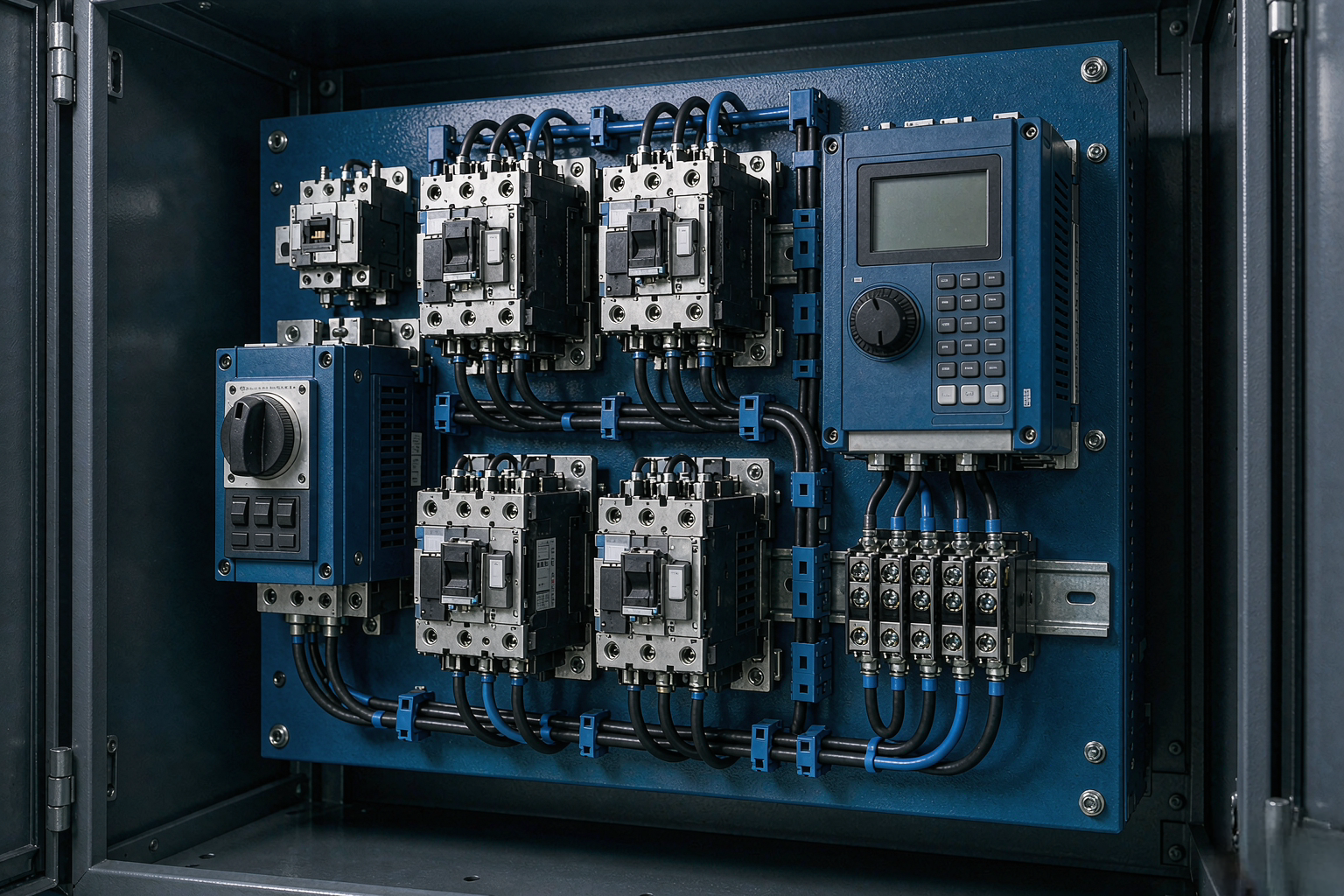
Why the Starting Method Matters
How a motor is started determines the inrush current it draws, the mechanical shock it transmits to the driven load, and the stress on the supply network. A pump, fan, conveyor, or compressor does not care how clever the control is, but it does care about the torque profile applied during the first seconds of acceleration. Choosing the wrong starting method can trip upstream breakers, crack couplings, or simply waste energy. This article compares the four most common approaches: direct-on-line, star-delta, soft start, and variable-frequency drive.
Direct-On-Line (DOL)
DOL is the simplest method: full line voltage is applied across the windings the instant the contactor closes. The motor develops high starting torque but draws five to eight times its rated current for the few seconds it takes to accelerate. DOL is cheap, reliable, and ideal for small motors or loads that are happy with a hard jolt, such as some centrifugal fans and small pumps. Its downside is the electrical and mechanical spike, which makes it unsuitable for large motors on weak networks or for fragile driven equipment.
Star-Delta
Star-delta reduces starting current by first connecting the windings in star, where each phase sees 58% of line voltage and starting torque is roughly one third of the DOL value. After the motor reaches speed, the contractor switches to delta for full-voltage running. The method is inexpensive and robust, with no power electronics to fail. The penalty is the torque step at the transition, which can cause a visible jerk and a brief current surge, and it only works for motors wound for delta-running with accessible winding ends. It remains a workhorse for medium-sized pumps and compressors where a soft start device is not justified.
Soft Starter
A soft starter uses thyristors to ramp the applied voltage smoothly from a low value up to full line voltage, controlling both current and torque during acceleration. Because it operates at line frequency throughout, it does not vary running speed, but it eliminates the step changes of star-delta and limits peak current to a set value, commonly two to four times rated. Soft starters are compact, cost less than a full VFD, and are excellent where the only requirement is gentle starting and stopping, such as conveyors, agitators, and positive-displacement pumps. They also support controlled ramp-down, reducing water hammer in pipelines.
Variable-Frequency Drive (VFD)
A VFD converts the supply to DC and back to AC at a variable frequency, letting the motor start at low frequency with low voltage and accelerate along a controlled speed-torque curve. Starting current is naturally limited because voltage and frequency rise together, often keeping inrush near rated current. Beyond starting, the VFD delivers full speed control, which is where its value explodes: fans and pumps obey the affinity laws, so a small reduction in speed yields a large reduction in power. For variable-load applications, a VFD typically pays for itself through energy savings alone.
How to Choose
The decision framework is straightforward. If the load is small and tolerant, DOL is unbeatable on cost. If you need to cut starting current on a fixed-speed load without speed control, star-delta or a soft starter fits, with the soft starter preferred where smooth stopping or frequent starts matter. If the load varies or you need precise speed, the VFD is the only option that delivers both gentle starting and ongoing energy savings. Network stiffness also matters: on a weak supply, limiting inrush is essential, pushing the choice toward soft start or VFD.
Practical Selection Checklist
Ask four questions: Does the load need speed control during operation? How fragile is the driven equipment? How strong is the supply network? What is the duty cycle? Fixed speed plus fragile load points to a soft starter; variable load plus energy focus points to a VFD; small tolerant load points to DOL. Star-delta remains a budget compromise when a soft starter’s features are not required.
Harmonics and Power Quality
Soft starters and VFDs are power-electronic loads that inject harmonics into the supply. A single drive is rarely a problem, but many on one feeder can distort the voltage waveform and overheat transformers and power-factor capacitors. In larger installations, consider line reactors, DC chokes, or active front ends to keep total harmonic distortion within IEEE 519 or local limits. DOL and star-delta impose no such concern, which is one reason they remain attractive for simple, isolated loads where power quality is otherwise clean.
Maintenance and Reliability
Reliability tends to follow complexity. DOL has almost nothing to fail beyond the contactor. Star-delta adds timer and interlock logic that must be set correctly. Soft starters concentrate failure risk in the thyristor bridge, which is generally robust but heat-sensitive and needs adequate ventilation. VFDs carry the most electronics and demand a clean, cool cabinet with good airflow. Match the method to the maintenance capability of the site: a remote facility with no drive expertise may favour the simplicity of star-delta over a VFD it cannot service.
Conclusion
There is no single best starting method, only the best fit for your load, network, and budget. Matching the starter to the application protects both the motor and the machine it drives while keeping energy and capital costs in check. For help selecting the right motor and control combination for your duty, visit motorolltech.com.