
Blog
IE3 vs IE4 vs IE5 Motor Efficiency Below 15 kW: Where Small-Motor Upgrades Pay Off

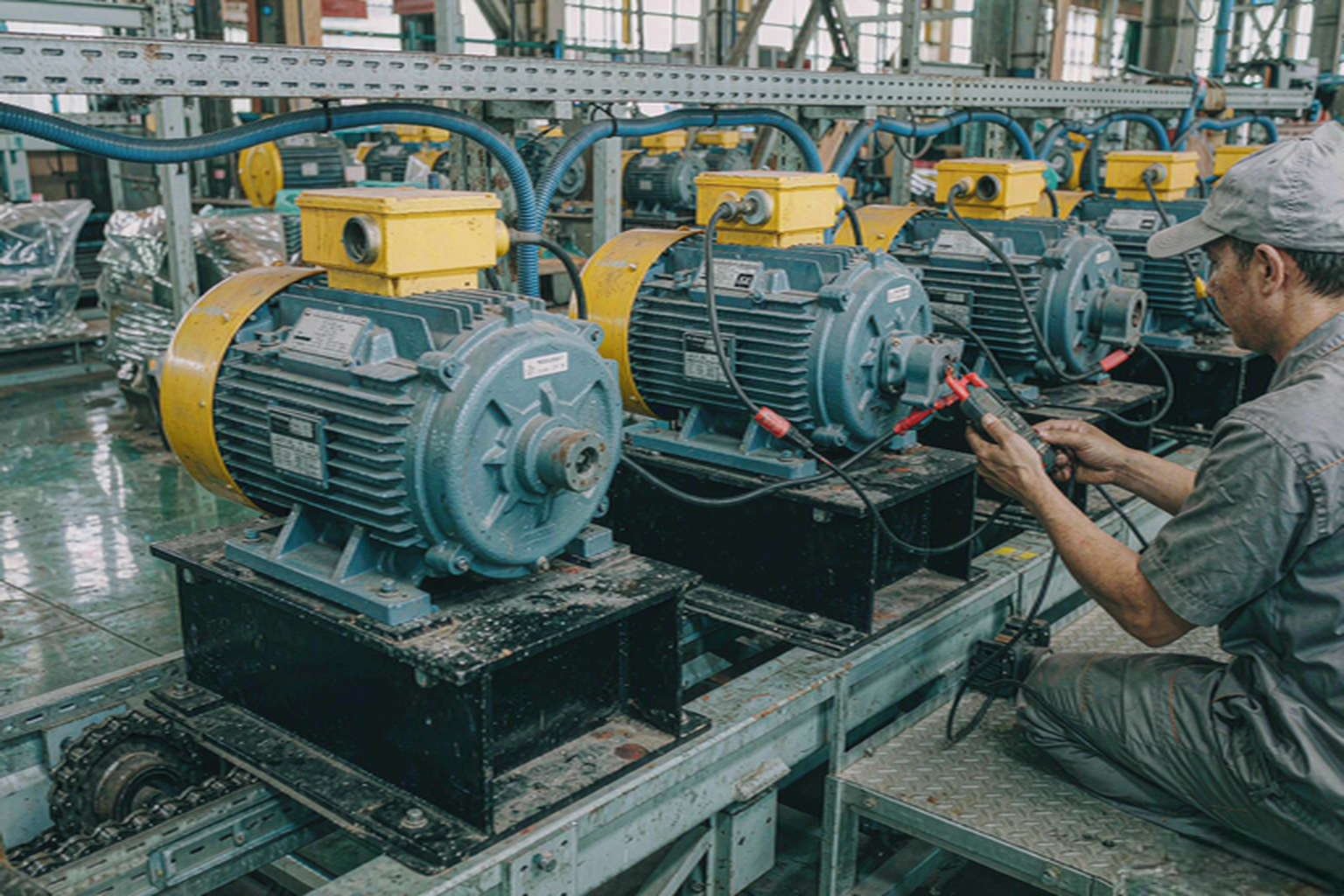
Search interest in IE3 vs IE4 vs IE5 motor efficiency keeps growing, and for good reason: energy prices have rewritten the payback math for electric motors across every industry. But most of the discussion, and most of the datasheets, centers on large motors above 15 or 22 kW, where absolute kilowatt-hour savings are impressive. In real plants, the majority of installed motors are small: conveyors, dosing pumps, small fans, mixers, compressors, and machine tool auxiliaries typically run below 15 kW. Whether an efficiency upgrade makes sense for this small-motor fleet is a different question from the large-motor case, and answering it well starts with understanding what the efficiency classes actually mean.
IE3 vs IE4 vs IE5 Motor Efficiency: What IEC 60034-30-1 Actually Defines
The international classification standard IEC 60034-30-1 does not define efficiency classes by a single percentage number. Instead, it defines them by losses: each higher tier requires roughly a 15 to 20 percent reduction in motor losses relative to the tier below, with IE5 targeting about 20 percent lower losses than IE4. In plain terms, IE3 is the Premium efficiency level, IE4 is Super Premium, and IE5 is Ultra Premium, a level usually achieved today by synchronous reluctance (SynRM) or permanent magnet (PM) designs rather than conventional induction technology.
When buyers compare the IE3, IE4 and IE5 efficiency tiers, the practical translation is this: an IE4 motor wastes roughly 15 to 20 percent less energy as heat than an IE3 motor of the same rating, and an IE5 motor wastes roughly another 20 percent less than an IE4. On a large motor, those fractions of saved losses amount to thousands of kilowatt-hours per year. On a small motor, the same fractions still apply, but the absolute numbers shrink dramatically, and that is where small-motor decisions get nuanced.
Why Small Motors Behave Differently
Consider a 5.5 kW motor running a conveyor twenty hours a day, 300 days a year. At roughly 6,000 operating hours annually and a typical load point near 75 percent, the motor draws on the order of 4 to 5 kW from the grid. If upgrading from IE3 to IE4 cuts losses by around 20 percent, the loss reduction might amount to only a few hundred watts. Multiplied over the year, that could save somewhere in the range of 1,500 to 2,500 kWh, depending on the actual load profile and the specific machines compared. At a typical industrial electricity price, the annual saving is real but modest, and the price premium for the IE4 or IE5 machine, which is proportionally larger on small frames than on large ones, may take several years to recover.
Several factors make small motors worse candidates on paper. First, fixed losses, such as friction, windage, and the magnetizing losses that keep an induction motor energized, represent a larger share of total losses on small frames, and efficiency ratings at full load do not capture how the machine behaves at partial load, where small motors often operate. Second, the relative price of higher-efficiency designs is higher on small frames because the engineering cost of SynRM or PM technology does not scale down with kilowatts. Third, small motors are frequently controlled by variable frequency drives anyway, and the drive, its control strategy, and the system it serves often dominate the energy picture more than the motor’s IE class.
Where the Upgrade Genuinely Pays Off
None of this means small motors should be ignored. The upgrade math turns favorable under conditions that are easy to check before spending anything:
- High operating hours. A small motor running continuously, such as a dosing pump or extraction fan that never stops, accumulates kilowatt-hours around the clock. Continuous-duty machines under 15 kW are the best upgrade candidates in the fleet.
- Electricity prices at the high end. Where industrial tariffs, demand charges, or self-generated power costs are elevated, every saved watt carries more value, shortening payback proportionally.
- Replacement timing. The best moment to upgrade is when the existing motor fails or a machine is being rebuilt anyway. Replacing a working IE3 motor purely for efficiency rarely pencils out; choosing IE4 or IE5 at the natural replacement point usually does.
- Incentives and regulations. Many regions offer rebates for super-premium efficiency upgrades, and minimum efficiency legislation continues to tighten, which changes the comparison baseline over time.
- Thermal and environmental stress. Lower losses mean the motor runs cooler. In hot ambient conditions or dusty environments, the cooler winding temperature of an IE4 or IE5 machine extends insulation life and reduces cooling demands.
Look at the System, Not Just the Nameplate
An IE5 motor efficiency rating means little without checking the duty cycle, the drive, and the driven equipment. The motor efficiency comparison only pays off when it is matched to how the machine actually operates. Three system-level checks deliver most of the value. First, measure the real load profile: a motor running at 40 percent load most of the time benefits far more from a drive with an optimized partial-load strategy than from a nameplate upgrade. Second, verify the drive pairing: SynRM and PM motors generally require a variable frequency drive for operation, so the comparison is really between an IE3 induction motor running direct-on-line and an IE5 package of motor plus drive, where the drive also unlocks speed control savings. Third, examine the driven load: a throttled pump or a damper-controlled fan wastes far more energy than any efficiency class difference, and fixing that first makes the motor upgrade genuinely additive.
Practical Selection Guidance for Small-Motor Fleets
For plants working through a small-motor population, a pragmatic sequence works well. Inventory motors below 15 kW and log their operating hours and load profiles, even roughly. Rank candidates by annual running hours multiplied by electricity price, since this single figure predicts payback better than the efficiency class alone. At the natural replacement points, default to IE4 where a drive is already present, and evaluate IE5 SynRM or PM packages for the continuous-duty machines at the top of the ranking. Standardize on one or two supplier families to simplify spares. Finally, verify the upgrade with measured data: compare electricity consumption of the upgraded machine against the logged baseline over a representative month, so that the fleet learns which upgrades actually deliver.
The Bottom Line on Small Motors
The IE3 vs IE4 vs IE5 motor efficiency question for motors below 15 kW is a ranking exercise rather than a yes-or-no decision. The tiers themselves are unambiguous, roughly 15 to 20 percent fewer losses at each step under IEC 60034-30-1, and the technology to reach IE5 is mature. What varies is the payback, which depends on operating hours, electricity cost, replacement timing, and whether the system around the motor is optimized first. Plants that apply those filters consistently find that a meaningful slice of their small-motor fleet, the continuous-duty, high-tariff, high-stress machines, justifies the upgrade today, while the rest can wait for natural replacement.
If you are weighing IE3 vs IE4 vs IE5 motor efficiency for your small-motor fleet, the selection guides and application notes at https://motorolltech.com cover payback evaluation, SynRM and PM options, and drive pairing in detail. Our engineers can help you rank your fleet and choose the upgrade path that actually pays.