
Blog
IE5 Synchronous Reluctance Motors: When Does Premium Efficiency Actually Pay Off?

IE5 Synchronous Reluctance Motors: When Does Premium Efficiency Actually Pay Off?
Motor efficiency has climbed steadily for two decades, driven by the IEC 60034-30 standard and regional minimum-energy-performance rules that have pushed the market from IE1 to IE3 as a legal floor in most industrialized economies. The newest tier, IE5 (super-premium), is now practical thanks to mature synchronous reluctance (SynRM) technology. But IE5 motors cost more up front, so the right question for any plant is not “is IE5 better” — it clearly is — but “when does the extra efficiency pay for itself?”
Recap: The IE Efficiency Classes
The IE label ranks motors by full-load efficiency at the rated operating point:
- IE3 (premium) — the current legal minimum for most general-purpose motors in the EU, UK, and many Asian markets.
- IE4 (super-premium) — roughly 1–2% more efficient than IE3, common in new high-duty installations.
- IE5 (super-premium+) — about another 1–2% over IE4, delivered by SynRM and high-efficiency permanent-magnet designs.
Those single-digit percentages sound small until you remember that a motor draws its purchase price in electricity within months of continuous running. Over a 10-year life, a 1% efficiency gain on a 75 kW motor can mean tens of thousands of dollars.
What Makes SynRM Different
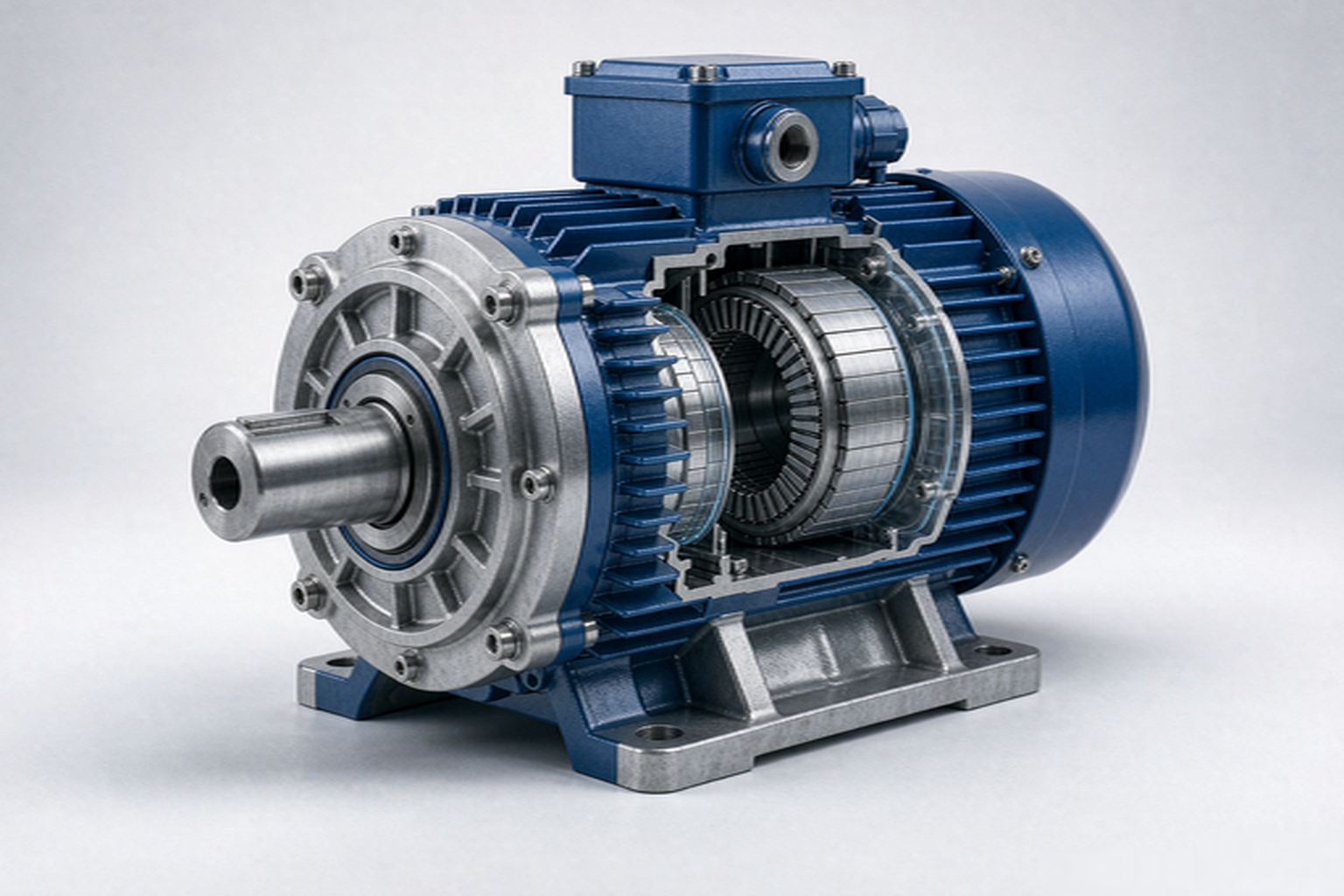
A synchronous reluctance motor has no rotor windings and no magnets. Its rotor is a solid salient-pole laminated core whose geometry forces the magnetic field to follow a longer, higher-reluctance path axially, producing torque purely by reluctance — the field “wanting” to align with the low-reluctance path. With no rotor losses (no I²R heating, no magnet eddy losses), SynRM reaches IE5 with a simpler, more robust rotor than a permanent-magnet machine. There are no rare-earth magnets to source, no demagnetization risk at high temperature, and the rotor runs cool.
IE5 vs IE4 vs IE3: The Numbers That Matter
Consider a 90 kW motor running 6,000 hours per year at $0.12/kWh:
- IE3 typical loss: ~6.5 kW → ~$4,680/year electricity for losses.
- IE4 typical loss: ~5.4 kW → ~$3,890/year.
- IE5 SynRM typical loss: ~4.5 kW → ~$3,240/year.
The IE5 unit saves roughly $1,440/year versus IE3 and about $650/year versus IE4 on losses alone. At that duty, the IE5 premium (often 10–25% of motor cost) frequently pays back in one to three years, after which it is pure saving for the rest of a 15–20 year service life.
When the Premium Pays Off
IE5 is the clear choice when:
- High duty cycle: continuous or near-continuous running (pumps, compressors, fans, conveyors) where loss dollars accumulate fast.
- High energy tariff: expensive or carbon-priced electricity makes every saved kW count.
- Thermal constraints: SynRM’s cool rotor helps in high-ambient or enclosed drives.
- Total-cost-of-ownership bids: procurement evaluated on lifecycle cost, not sticker price.
IE5 is harder to justify for intermittent, low-hours applications (e.g., a standby booster run a few hundred hours a year), where the efficiency gain never accumulates enough to beat the premium. For those, a well-specified IE4 is usually the sensible stop.
Pairing IE5 With a VFD
SynRM motors are designed to run with a variable-frequency drive, and the combination unlocks efficiency beyond the nameplate: at part load the drive lowers speed to match demand, so you save both the IE5 rotor efficiency and the part-load gains of variable speed. The drive must support SynRM control (open-loop or closed-loop reluctance algorithms) — most modern industrial VFDs do. Proper motor-cable screening and drive tuning protect the low-reluctance rotor from torque ripple and keep acoustic noise low.
Conclusion
IE5 synchronous reluctance motors are no longer a lab curiosity; they are a proven, magnet-free route to super-premium efficiency with a compelling lifecycle case wherever motors run hard. The decision is a TCO calculation, not a spec-sheet reflex — but for the majority of continuous-duty industrial loads, IE5 already wins on money and on carbon.
Need help modeling IE5 vs IE4 payback for your duty cycle? Visit motorolltech.com for motor selectors, VFD pairing guides, and engineering support on specifying the right efficiency class.